



 OFFERS
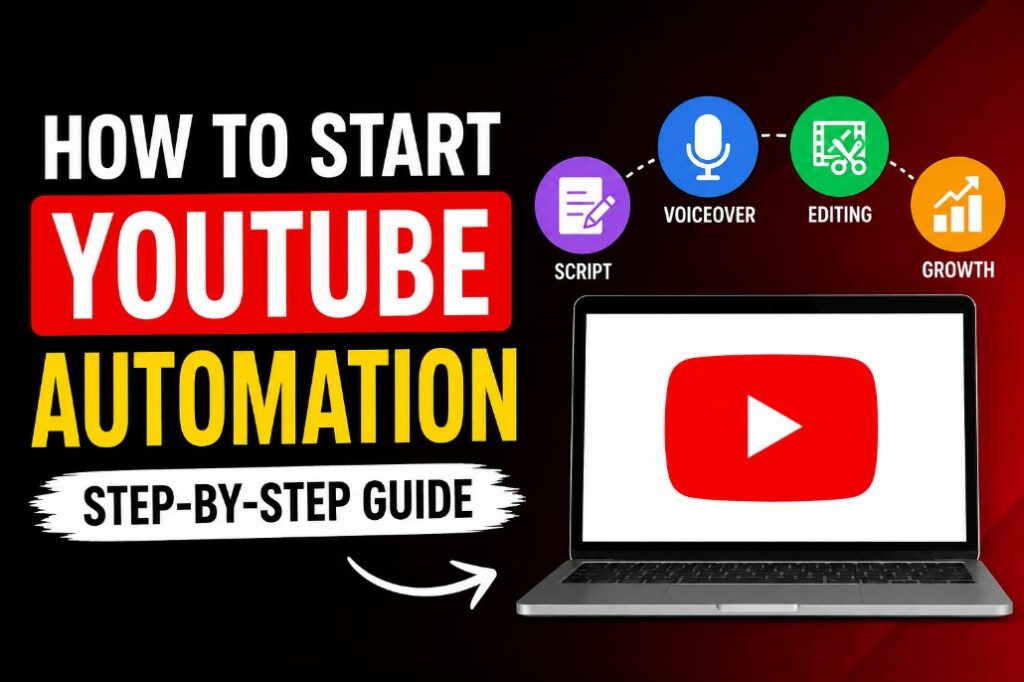
YouTube automation gets a bad reputation. And honestly? Much of that criticism is deserved.
For every legitimate channel run by a smart operator, there are ten get-rich-quick schemes selling dreams of passive income while you sleep. But here’s the truth: YouTube automation is not a shortcut. It is a business model. And like any business model, it requires strategy, capital, and consistent effort.
If you are willing to treat this seriously, 2026 is actually a great year to start. The noise from low-quality, AI-generated content is finally being filtered out by YouTube’s algorithm. That means real, well-produced faceless channels have room to grow.
Let me walk you through exactly how to start, step by step.
What YouTube Automation Actually Means
First, let’s clear up a common misunderstanding. YouTube automation does not mean you set up a channel and never touch it again. That does not exist.
What it means is this: you remove yourself from the day-to-day production work. You do not need to be on camera. Editing footage is optional. Writing every script is not required either.
Instead, you act as the producer or channel manager. You hire freelancers to handle scripting, voiceover, editing, and thumbnails. Your job becomes strategic—finding topics, managing workflows, and optimizing for growth. The channel runs on systems, not on your personal time.
This model works for one simple reason: YouTube rewards consistency and quality, not personality. A well-researched documentary about ancient engineering will get views whether a famous face hosts it or not.
Why 2026 Is Different
If you watched YouTube automation tutorials from 2022 or 2023, much of that advice is now outdated.
Back then, channels could get away with basic slideshows, robotic text-to-speech voices, and loosely rewritten Wikipedia articles. Those channels made money for a while. Then YouTube updated its policies on “reused content” and “low effort,” and many of them lost monetization overnight.
In 2026, the bar is higher. Viewers expect clean audio, dynamic visuals, and original analysis. The algorithm is better at detecting generic AI scripts. But here is the opportunity: most people trying automation are still doing low-quality work. If you commit to genuine quality, you stand out immediately.
Step 1: Choose a Niche That Works Without a Host
Not every topic works for automation. You need subjects where the value comes from information and visuals, not from a personality.
Strong automation niches in 2026 include:
- Historical documentaries. Deep dives into specific battles, ancient civilizations, or forgotten events. Viewers come for the story, not the storyteller.
- Business case studies. How a company succeeded or failed. The rise and fall of brands. Financial breakdowns.
- Science and technology explained. Space exploration, artificial intelligence, engineering principles. These topics naturally rely on diagrams and footage.
- True crime. This remains consistently popular. The key is thorough research and respectful storytelling.
- Urban planning and architecture. Why cities are designed certain ways. The history of famous buildings. These channels have loyal, engaged audiences.
Avoid niches that demand personality or real-time reactions. Gaming, vlogging, political commentary, and fitness are difficult to automate well.
Step 2: Build a Simple Production Workflow
You need a repeatable system. Here is the workflow that successful automation channels use.
Research and scripting. Start with a strong angle. Do not just summarize a Wikipedia page. Find a specific question or tension. “Why did the Roman Empire really fall?” is too broad. “One tax policy that destroyed Rome” is better. Hire a freelance writer on Upwork or a specialized scriptwriting service. Expect to pay between 40and80 for a well-researched 8-minute script.
Voiceover. Human voices win in 2026. AI voices are recognizable, and viewers click away. You can find professional voice actors on Fiverr starting at 15to30 per video. Look for samples with clear enunciation and natural pacing. A boring voice will kill great content.
Visuals and editing. You will need stock footage, animated graphics, or sourced clips. Pexels, Storyblocks, and Artgrid are solid options for royalty-free footage. An editor will assemble everything to match the script. For an 8-minute documentary-style video, professional editing typically costs 80to150 depending on complexity.
Thumbnail and title. Never outsource this to a general editor. The thumbnail is the single most important variable for click-through rate. Hire a dedicated thumbnail designer. Pay 15to30 per thumbnail. Use high contrast, readable text, and a clear focal point.
When you add everything up, a professional automation video costs between 150and300. That sounds expensive. But a $50 video will not perform in 2026. You are investing in an asset that can generate revenue for years.
Step 3: Understand the Monetization Requirements
Before you see a single dollar, your channel needs to qualify for the YouTube Partner Program.
As of 2026, the requirements are:
- 1,000 subscribers
- 4,000 public watch hours (or 10 million Shorts views)
Most automation channels take between 4 and 9 months to hit these numbers with consistent weekly uploads. That means you need financial runway. Plan to invest in at least 10 to 15 videos before monetization kicks in.
Once monetized, revenue comes from several sources. Ad revenue is the most predictable. With documentary-style content in finance or history, RPM (revenue per thousand views) typically ranges from 5to15. A video that gets 50,000 views might earn 300to500 over time.
Additional revenue streams include affiliate links (recommending books or software), sponsorships, and selling digital products like research templates.
Step 4: Avoid the Most Common Mistakes
I have seen dozens of automation channels fail for the same reasons. Here is what kills growth.
Using only AI for scripts. YouTube can detect low-effort AI generation. More importantly, viewers feel it. AI writes bland, factually loose paragraphs. A human writer adds opinion, narrative tension, and a clear voice.
Ignoring audio quality. Viewers will tolerate average visuals. They will not tolerate bad audio. A quiet, echoey voiceover with background noise will destroy retention. Pay for a decent microphone if you record yourself, or hire professionals.
Stealing clips. Do not rip long segments from Netflix or other YouTube channels. Copyright claims will demonetize your video or get it removed. Use stock footage, public domain archives, or properly licensed clips. For commentary and criticism, keep borrowed clips under a few seconds each.
Posting inconsistently. The algorithm trusts channels that publish on a schedule. Once a week is the standard. Every two weeks can work. Random posting every few months will kill momentum.
Step 5: The Long-Term Strategy
Most people think about YouTube automation as a short-term income hack. That is exactly why most people fail.
The smarter approach is to treat your channel as a media asset. Each video you publish is a piece of intellectual property that can earn money for years. A well-made history documentary from 2024 might still generate daily views in 2026 and 2027.
Once your first channel becomes profitable, you can reinvest earnings into a second channel. Some operators run three or four channels across different niches. But do not expand until your first channel runs smoothly with minimal daily oversight.
Is YouTube Automation Worth It in 2026?
Yes, but only if you go in with realistic expectations.
This is not a replacement for a full-time job in month one. For most people, it is a side business that takes six to twelve months to become profitable. Once profitable, a well-run automation channel can earn a respectable monthly income with ten to fifteen hours of management per week.
The people who succeed are not looking for shortcuts. They are looking for systems. Deep research is their habit. Quality is something they’re willing to pay for. Fair treatment of freelancers is also a priority.
And they stay patient through the slow early months.
If that sounds like you, 2026 is a fine time to start. The low-quality competition is dropping out. The audience is still hungry for information. And the model works when you do the work.
You can also see – How to use movie clips on YouTube without copyright



One thing that stood out to me is how important niche selection and consistent uploads still are, even with automation tools getting more advanced in 2026. A lot of people think YouTube automation is completely hands-off, but channels usually grow faster when there’s still a clear content strategy and audience focus behind the scenes. Curious to see how AI-generated content policies will shape this space over the next year.
This guide on starting YouTube Automation in 2026 is incredibly timely, especially the emphasis on shifting away from generic content toward building sustainable, faceless channels that actually resonate with audiences. It’s refreshing to see a roadmap that focuses on long-term consistency rather than just chasing quick views or short-term trends. Definitely a solid resource for anyone looking to navigate the evolving landscape of auto-pot channels effectively.